Peer-reviewed research confirms that creatine cannot enter the muscle cell without a specific electrolyte co-transport mechanism most athletes have never heard of, and most supplement companies never mention.
If you have been taking creatine consistently for more than a few weeks and your performance is not where the research suggests it should be, the problem is almost certainly not the creatine. The problem is what is happening, or more accurately not happening, before the creatine reaches the muscle cell.
Creatine monohydrate is the most studied supplement in exercise science. Over 500 peer-reviewed trials. Documented improvements in peak power, training volume, sprint recovery, and lean mass. The science is not in question. The clinical dose is established at 5 grams per day. The safety record spans decades of use across populations from elite athletes to adults over seventy.
What most of that research does not communicate clearly enough is this: creatine does not enter muscle cells passively. It requires a dedicated protein transporter. That transporter has a specific dependency that determines how much of the creatine you take actually makes it into the muscle where it can do anything useful.
Understanding that dependency changes how you supplement. Permanently.
Creatine is a polar molecule. It cannot cross the hydrophobic lipid bilayer of the muscle cell membrane on its own. To enter the cell, it needs a transporter: a specific protein embedded in the membrane that binds creatine molecules from the extracellular fluid and moves them inside.
That transporter is called CreaT1, formally SLC6A8. It is a member of the sodium-dependent neurotransmitter transporter family, the same class of proteins that moves dopamine and serotonin across membranes in the brain. It is not a passive channel. It is an active pump. And it requires something specific to operate.
For every single creatine molecule the CreaT1 transporter moves into the cell, two sodium ions (Na+) and one chloride ion (Cl-) must bind simultaneously. The transporter is driven by the electrochemical sodium gradient across the cell membrane: high sodium outside, low sodium inside. The greater the gradient, the more transport events per second. Reduce available sodium and the transporter slows.
The implication is direct: your extracellular sodium level at the time of training is a rate-limiting variable for creatine absorption. Not the dose you are taking. Not the brand. Not the timing. Sodium.
In 2011, Dai and colleagues examined creatine uptake in skeletal muscle under different extracellular electrolyte conditions. When calcium and magnesium were removed from the extracellular fluid, creatine uptake decreased by 47 percent. When sodium and chloride concentrations were increased above baseline, uptake increased.
The finding was not subtle. Nearly half of the creatine you take can fail to enter the muscle in an electrolyte-depleted state. And "depleted" does not require clinical deficiency. It requires only the sodium loss that occurs during a normal training session in most athletes following typical dietary patterns.
A subsequent randomized, double-blind crossover trial published in 2018 in the Journal of the International Society of Sports Nutrition (PMC5930494) put this directly to the test. Recreationally trained athletes were supplemented with four conditions over six weeks each: creatine alone, electrolytes alone, combined creatine and electrolytes, and placebo.
The combined condition outperformed creatine alone on every single measured outcome. Peak power improved by four percent. Mean sprint power improved by five percent. Vertical jump showed the largest gap: 8.4 percent in the combined group versus 3.1 percent with creatine supplemented without electrolytes. The electrolytes were not the primary driver. Creatine was. But electrolytes determined how much of that creatine the muscle actually used.
"Creatine transport is primarily dependent on electrogenic transporter proteins, requiring at least two sodium ions and one chloride ion to transport one creatine molecule across a cellular membrane."
Western Washington University, PMC5930494, 2018
The supplement industry categorizes electrolytes as hydration products. This is a marketing category, not a physiological one. Sodium, potassium, and magnesium are not just fluid management tools. They are the operating conditions for cellular function.
Sodium maintains the electrochemical gradient that drives CreaT1 transport. It also regulates plasma volume, the blood volume available to deliver oxygen and nutrients to working muscle. Athletes following low-sodium dietary approaches are often depleting the very environment that creatine transport depends on.
Potassium maintains the resting membrane potential that determines whether a muscle fiber responds to neural drive at all. During high-intensity training, intracellular potassium can fall by 30 percent. The result is not fatigue in the traditional sense. It is a literal ceiling on force production. The muscle stops responding to the signal to contract.
Magnesium is a required cofactor for creatine kinase, the enzyme that converts free creatine into phosphocreatine inside the cell. Without sufficient magnesium, the enzyme cannot operate at full capacity. This means that even creatine that successfully enters the cell cannot be fully converted to the stored form that powers ATP regeneration. Magnesium deficiency is particularly common in hard-training athletes due to consistent sweat losses.
The problem is not just one of these deficits in isolation. Most athletes who train at high intensity while following low-sodium diets are walking into sessions with reduced transport capacity (from sodium), reduced membrane potential (from potassium), and reduced creatine kinase function (from magnesium) simultaneously. Each deficit compounds the others. And the creatine they are spending money on is operating at a fraction of its documented ceiling.
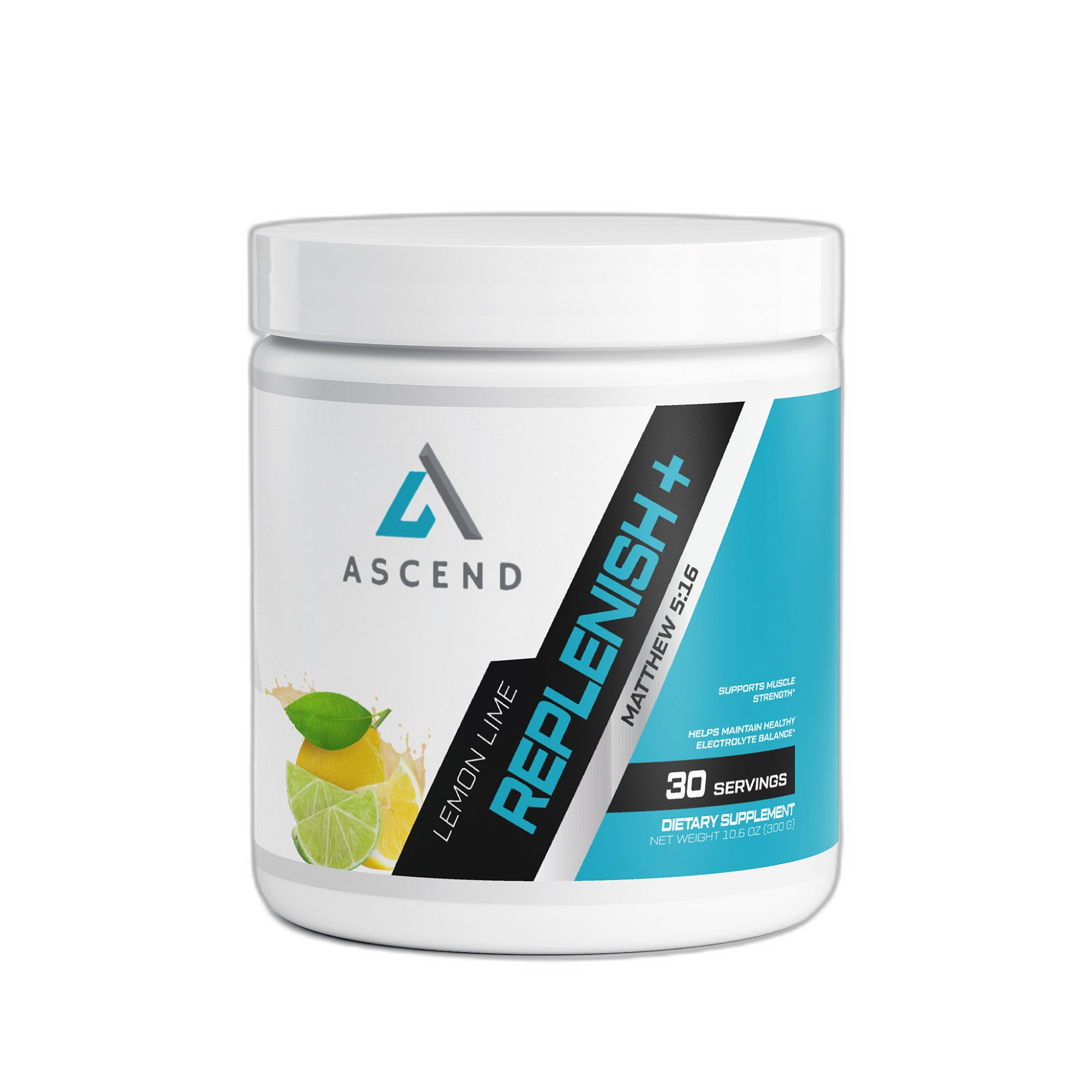
Every ingredient in Replenish Plus is dosed against the peer-reviewed literature, not against a minimum-viable threshold chosen to reduce manufacturing cost.
| Ingredient | Dose | Function | Evidence Standard |
|---|---|---|---|
| Creatine Monohydrate | 5g | PCr pool expansion; ATP regeneration; training volume; power output | ISSN-validated clinical maintenance dose |
| Sodium (as sodium chloride) | 1,000mg | CreaT1 co-transport; plasma volume; muscle excitability | Meets ACSM peri-workout guideline for sessions over 60 min |
| Potassium (as potassium chloride) | 200mg | Resting membrane potential; force production; intracellular fluid balance | Within evidence-based daily supplementation range |
| Magnesium (as magnesium malate) | 66mg | Creatine kinase cofactor; ATP-Mg complex formation; muscle relaxation | Malate form selected for superior bioavailability vs. oxide |
No proprietary blends. No underdosed "trademarked" forms of common compounds. No ingredients that do not have a documented mechanism relevant to athletic performance. What you see on the label is what is in the product, dosed at the level the research supports.
Take one scoop of Replenish Plus with 16 to 20 ounces of water, 30 to 60 minutes before training. On non-training days, take at any consistent time. Consistency is more important than timing on rest days.
If you are starting without a creatine foundation, you can use a loading protocol (20g per day split across four servings for seven days, then drop to one serving daily) or simply start with one serving per day and reach full saturation at day 28. Both protocols produce the same long-term outcome. Loading is faster. Maintenance is simpler.
Adding carbohydrates to your serving accelerates creatine retention via insulin-stimulated transport. If you train fasted, maintenance-phase benefits will accumulate more gradually but still fully over 28 days.
This is not a lifestyle supplement. This is a performance optimization for athletes who take training seriously and have no interest in paying for two products when one does the same job better.
Creatine draws water into muscle cells, which is part of how it works. This is intracellular hydration, not subcutaneous water retention. It does not cause the puffy appearance associated with sodium-driven extracellular retention. Most athletes notice nothing. Some athletes in the first week of a loading protocol report 1 to 3 pounds of scale weight. That is water in the muscle, not fat, and it is not a negative outcome.
With a loading protocol (20g per day for 7 days), intramuscular phosphocreatine stores reach near-saturation by day 7 to 10. Without loading, full saturation takes 28 days at one serving per day. Most athletes notice training quality improvements, specifically increased work capacity and faster between-set recovery, between days 14 and 21 on maintenance dosing.
The central issue is timing. CreaT1 transport efficiency depends on extracellular sodium being present at the moment creatine is in the bloodstream. If you take creatine in the morning and electrolytes at a different time, you may not be capturing the co-transport benefit. Replenish Plus co-delivers both mechanisms in one serving, ensuring optimal conditions at the time of absorption. The cost savings of $35 per month are secondary to the protocol alignment.
Every order includes a 30-day satisfaction guarantee. If you do not see measurable improvements in training quality within 30 days of consistent use, contact us for a full refund. No forms, no return required, no questions beyond what happened. That is the standard, not the fine print.
Creatine monohydrate has one of the strongest long-term safety records in supplement science. Studies spanning up to five years of continuous use in healthy adults show no adverse effects on kidney function, liver markers, or any tracked health parameter. The ISSN's position stand categorizes creatine monohydrate as safe and effective for use by healthy athletes. If you have a pre-existing kidney condition, consult your physician before starting any creatine protocol.
Subscribe and your first month of Replenish Plus is $31.49. Every month after that, $35.99. Compared to $70 to $80 per month buying creatine and electrolytes separately, you get both mechanisms, one scoop, and more than $400 back per year.